Key takeaways
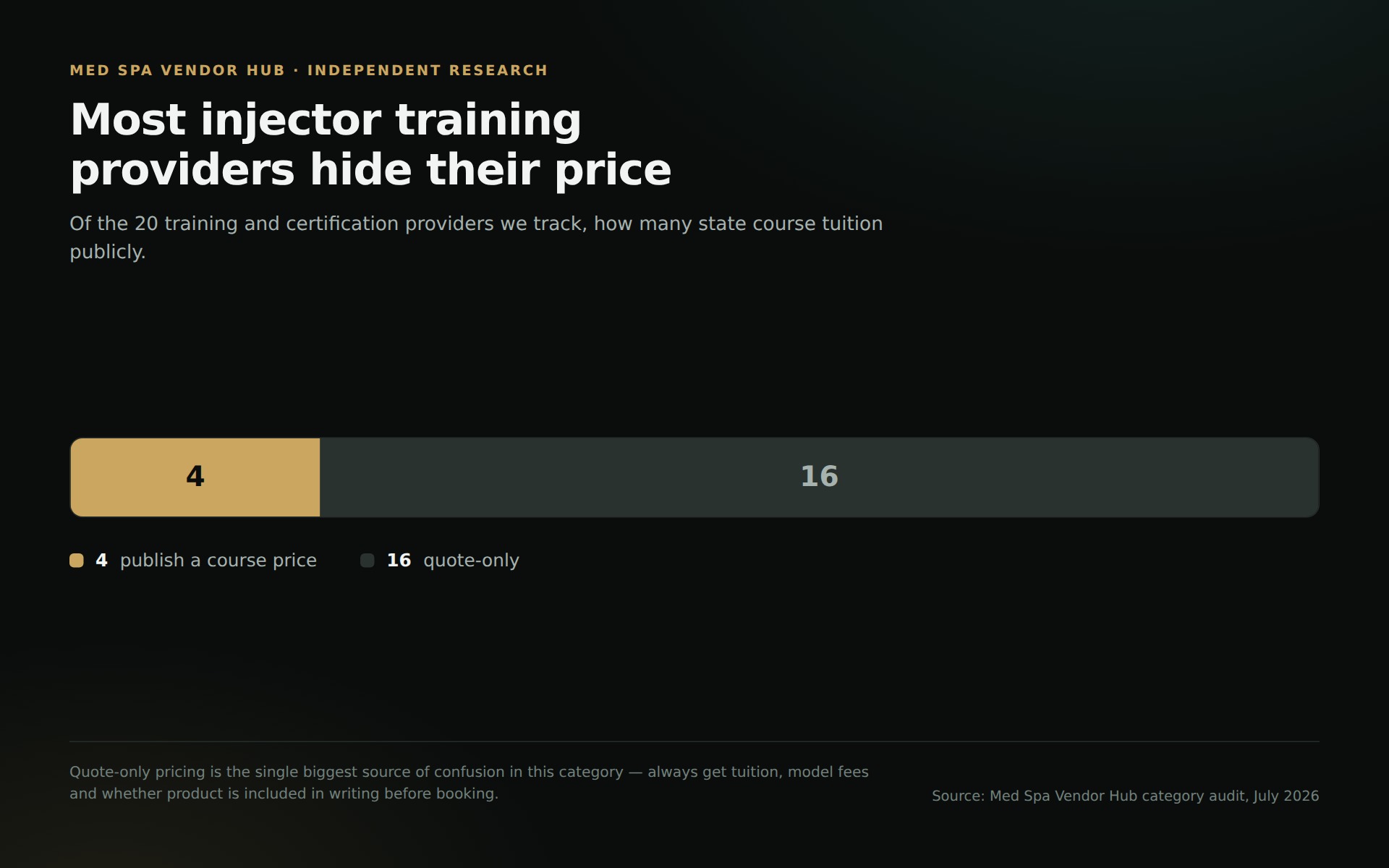
- Only 4 of the 20 injector training providers we track publish a course price — quote-only pricing is the norm and the main source of buyer confusion.
- Supervised injection repetitions per student is the variable that predicts competence; PracticalCME caps cohorts at 5–6 and Injectables EDU publishes 1:6 with a 12-person cap.
- Allergan Medical Institute offers the deepest curriculum (30+ supervised hours at 3:1) but is product-tied and not open enrolment — a second credential, not a first.
- AmSpa scores highest overall and teaches business, legal and compliance, not injection — buy it alongside a hands-on academy, never instead of one.
- Published tuition spans $199 (AACM, online didactics) to ~$2,000 (AMET, hands-on) — a format gradient, not a quality one.
- Empire has unmatched scale and rare published pricing ($1,899 list, $1,699 on sale, $2,049 in New York) but the most independent criticism in our directory; ask for class size in writing before enrolling.
- No certificate expands your legal scope of practice — your licence and state delegation rules do.
Injector training is the highest-stakes purchase in aesthetics and the least transparent. Providers compete on marketing language — "hands-on", "live models", "certification" — that carries no fixed meaning, and most will not tell you what a course costs until you speak to someone.
We track 20 training and certification providers. Four publish a course price.
That opacity is the context for everything below. The ranking that follows is based on our independent MSVH scores, and the single criterion that separates the top from the middle is not brand recognition — it is supervised injection repetitions per student.
The ranking
Allergan Medical Institute — 4.3 · the clinical benchmark
AMI is AbbVie's education arm and, by some distance, the most rigorous injectable curriculum available: a five-day Foundational Injectables intensive with 30-plus supervised hours on live models at a 3:1 ratio, plus a four-month Evolving Injectables mentorship track. Nothing else in the category matches that hands-on volume.
The catch is access. It is product-tied — generally requiring an Allergan account and portfolio commitment rather than open enrolment — with no published tuition and eligibility running through sales relationships. Treat it as the second credential you earn once you carry accounts, not the first one you buy.
AmSpa — 4.4 · the wrong tool for injecting, the right one for owning
AmSpa scores highest on this page and is not injection training at all. It is the industry's trade association, delivering business, legal and compliance education through two-day Boot Camps, an online Learning Center and the annual Medical Spa Show, at published membership pricing ($395/yr Basic, $845/yr Plus).
If you are opening a med spa, AmSpa is the single most valuable education purchase you can make — and it will not teach you to inject. Clinical content is largely an add-on rather than core curriculum. Buy it alongside a hands-on academy, not instead of one.
Galderma GAIN — 4.1 · scale and regional access
GAIN trains a company-reported 100,000-plus healthcare professionals a year through 800 global trainers, with a structured pathway for newer injectors via ASCENT and a codified methodology applied consistently across a huge trainer network. Regionally accessible in a way boutique programmes cannot match.
Same structural caveat as AMI: product-tied to the Dysport, Restylane and Sculptra portfolio, no open enrolment, pricing effectively bundled into product commitments.
AAFE — 4.1 · the broadest curriculum
AAFE has trained 25,000-plus clinicians across Levels I–III plus TMJ and therapeutic programmes, running 400-plus courses a year at 50-plus locations. Toxin and product are included in tuition, which makes training-day costs predictable — a genuine advantage when rivals bill product separately.
Its heritage is dental, so examples and peer cohorts skew that way, and tuition is quote-based. For a dentist or a multidisciplinary clinician wanting a structured Level I–III pathway, it is the strongest open-enrolment option.
PracticalCME — 4.1 · the most needle time per student
PracticalCME caps in-person hands-on sessions at five participants on its Botox and filler course page — though three other pages on the same site say six, so treat it as five-to-six rather than a settled number — taught exclusively by physician faculty on live patients, with online didactics completed before travel. Note that attendees are expected to supply their own patient model. On the metric that matters most — supervised injections per student — it is the best open-enrolment programme in the category.
It is premium-priced and quote-based, across a smaller 14-city footprint. If your budget stretches to one course and you want to leave genuinely competent, this is the shortlist.
IAPAM — 4.0 · aesthetics plus GLP-1 plus business
IAPAM's Aesthetic Medicine Symposium is the rare programme combining injectables, medical weight loss and a business track in one CME-based, physician-led event with no manufacturer product commitment. Restricted to MDs, NPs and PAs — RN injectors are largely outside its scope.
Injectables EDU — 4.0 · best ratio for nurse injectors
Injectables EDU is nurse-founded and nurse-focused, with one of the tightest published ratios in the category: maximum 12 attendees at 1:6, plus 6.35 AANP contact hours. Hands-on is limited to four cities, but for an RN or NP wanting small-cohort supervision from a curriculum built for their licence, the ratio speaks for itself.
AAOPM — 3.9 · fastest accredited route at a published price
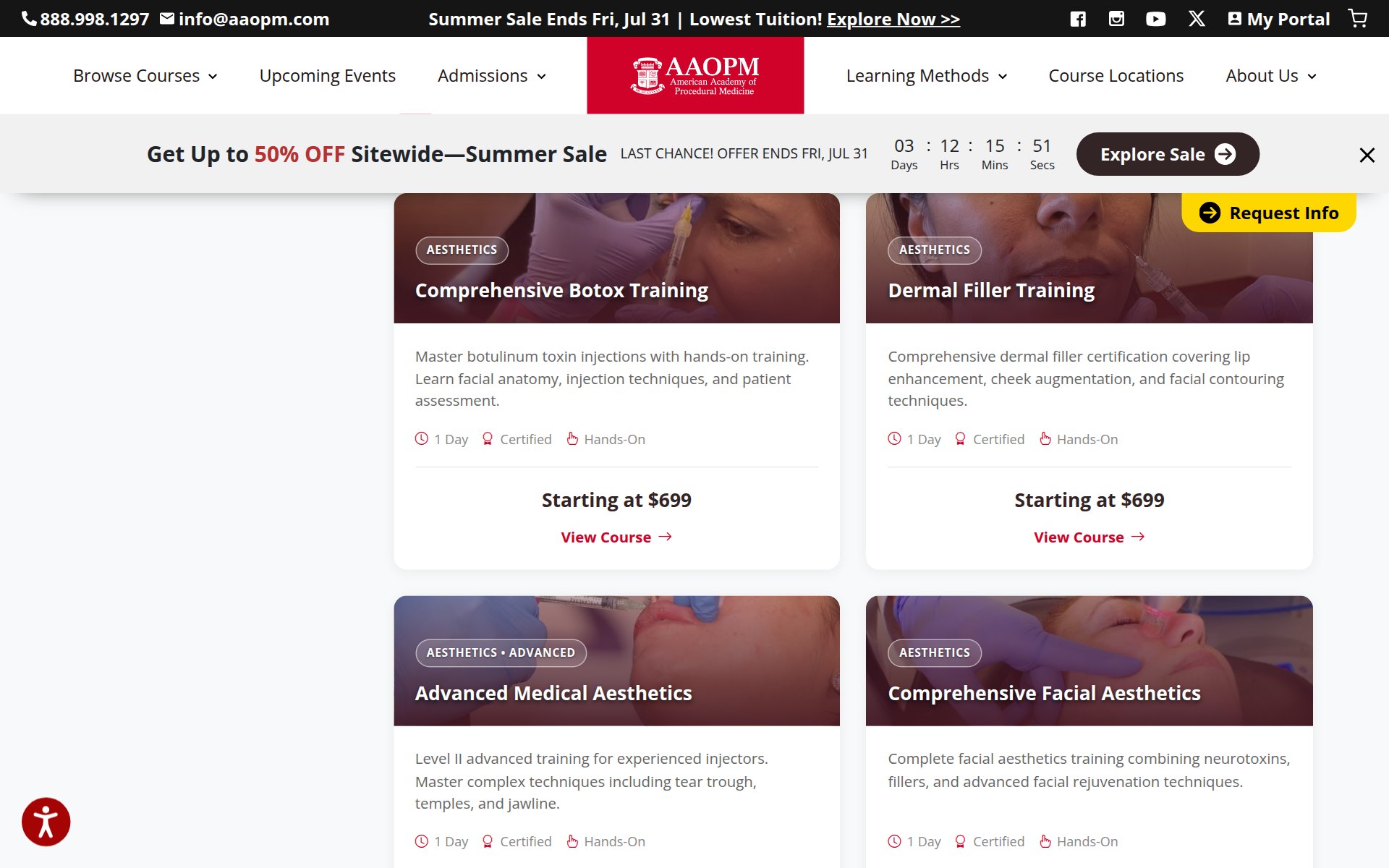
AAOPM is a 28-year-old CME body offering one-day hands-on certifications on live patients with genuine ACCME accreditation (8 credits on the Botox course) — and rare published pricing: advertised from $699 for livestream (listed Botox livestream dates run $799) and $1,699 in-person. The one-day format inherently limits repetition versus multi-day programmes, and the high-volume model means less individual attention.
Esthetic Skin Institute — 3.9 · heritage live-model training
ESI has operated since 1997, claims to have pioneered live-model hands-on aesthetics training, and keeps cohorts clinical-only so pacing suits medical professionals. Smaller national footprint, unpublished tuition.
Empire Medical Training — 3.8 · scale and published prices, with caveats
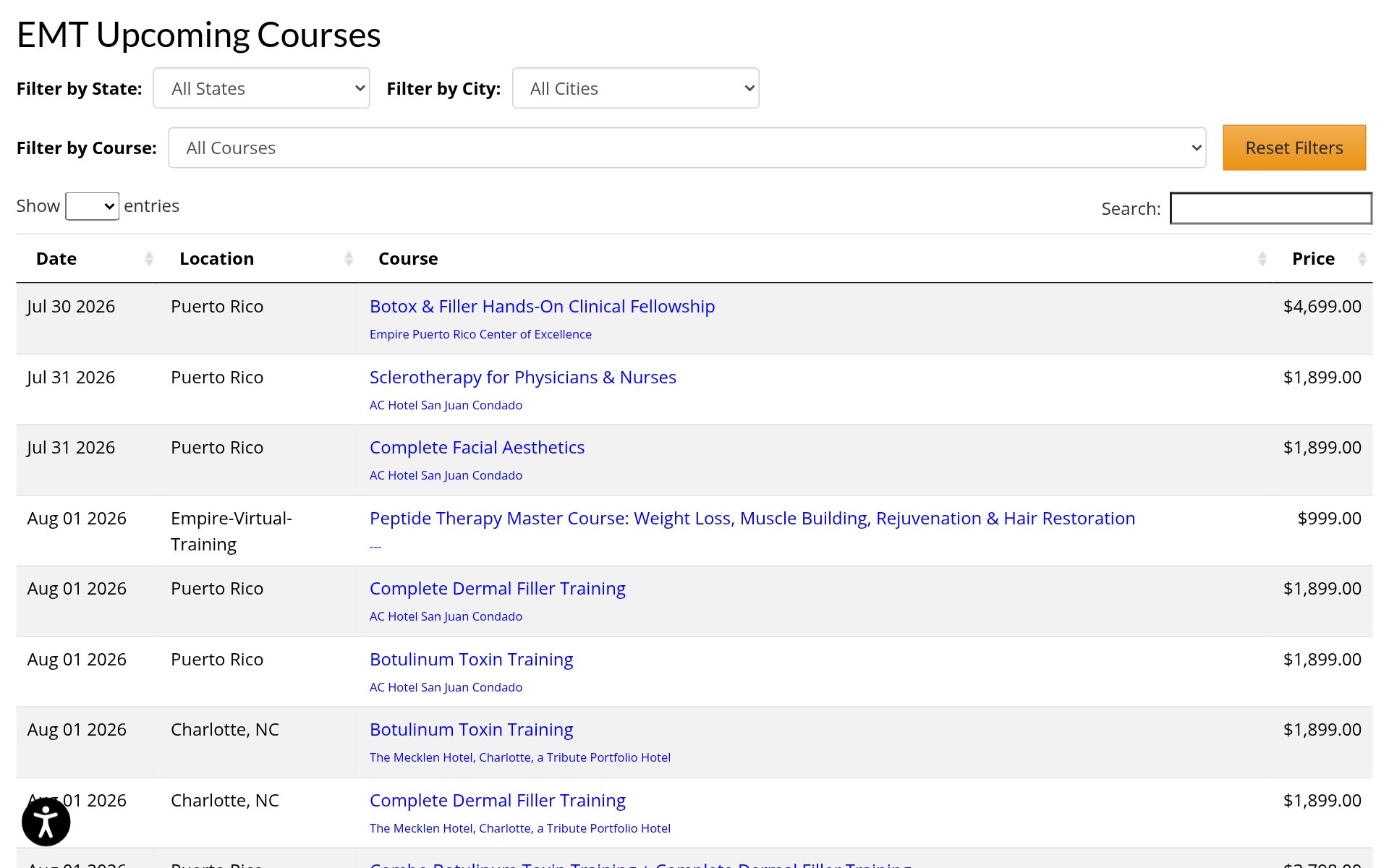
Empire is the highest-volume aesthetics educator in the US — 175,000-plus graduates since around 1998, 700-plus locations — and one of the few publishing tuition ($1,899 list for both botulinum toxin and dermal filler training, $2,049 in New York, discounted to $1,699 on its current sale).
It also carries the most independent criticism in our directory: undisclosed class sizes, limited per-student hands-on time, and BBB complaints worth reviewing before enrolling. The scale and price transparency are real; so is the variance in what a given course day delivers. Ask for the specific class size in writing.
Palette Resources — 3.8 · cadaver-lab refinement for practising injectors
Palette runs tiered technique-refinement workshops with cadaver and anatomy labs across toxins, HA fillers, Sculptra and deoxycholic acid, from four-hour Level I sessions to two-day immersions. Anatomical rigour few competitors match — but explicitly not for beginners, and bring-your-own-model and product logistics add cost.
AACM — 3.8 · cheapest accredited didactics
AACM offers surgeon-led online Botox certification — 13 modules, 8.5 hours, 8.5 CME credits with joint ACCME/ACPE/ANCC accreditation — at a published $199. Genuine accreditation at the lowest published price in the category.
Understand what it is: online-first, so far less needle time than an in-person intensive, with hands-on shadow days optional and separately quoted. Excellent didactic foundation; not a substitute for supervised injection.
National Laser Institute — 3.8 · the device answer, not the injectables one
NLI is the recognised name in US laser certification, with a deep device-training bench and the useful property of serving estheticians and laser techs that injector academies exclude. Independent reviews are mixed specifically on injectables transparency and marketing; tuition is quote-based. Use it for devices.
Also worth knowing: AAAMS (hybrid format plus ongoing credential), Aesthetic Mentor and The Aesthetic Immersion (boutique, surgeon- and NP-led, regionally anchored), Derma Medical (codified landmark-based method, roughly 50% hands-on), Derma Institute (six metros, live models), and RMD Training, which pairs graduates with a mentor afterwards — addressing the category's real weakness, the post-course support cliff.
What the published prices look like
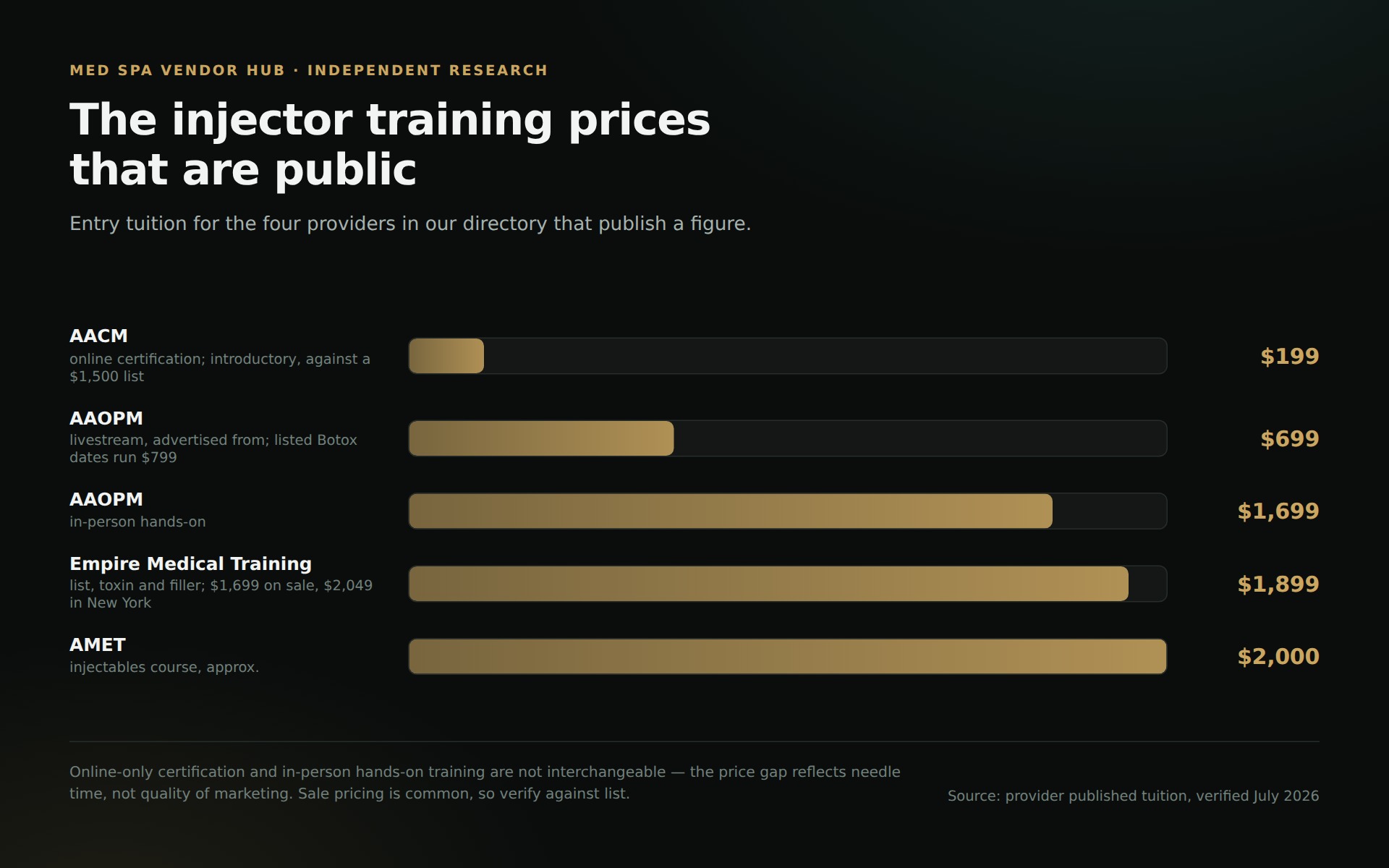
The spread from $199 to $2,000 is not a quality gradient — it is a format gradient. The $199 course is online didactics with accreditation. The $2,000 course puts a needle in your hand. Comparing them on price alone is the most common mistake buyers make in this category.
The five questions that actually separate programmes
Ask these in writing before paying. Programmes confident in their rigour answer directly; evasion is the most reliable red flag in this market.
- What is the class size and the instructor-to-student ratio? Injectables EDU publishes 1:6 with a 12-person cap; PracticalCME caps at five to six. If a provider will not state a number, assume it is large.
- Live models or mannequins? And who supplies the models — you or them?
- How many units and syringes will I personally inject? Not "how much hands-on time" — repetitions.
- Is product included in tuition? AAFE includes toxin and product; Palette requires you to bring your own. This can swing the real cost by hundreds.
- Who accredits it? ACCME, ANCC, AANP or ADA CERP means outside review and hours that count toward licence renewal. A programme that says "certification" without naming an accreditor is selling a course, not a credential.
The thing no course can give you
No certificate expands your scope of practice. Your licence and your state's delegation rules determine what you may legally do, and states differ sharply on who may inject, what supervision an RN requires, and what constitutes a good-faith exam. Check your board's position before tuition, not after.
For the decision framework, see our buying guide for med spa training and what training costs. For how credentials are actually regarded by employers and insurers, see med spa certifications explained. And for a direct head-to-head, Empire Medical Training vs AAFE.
Frequently asked questions
Which Botox training provider is best?
It depends on your licence and stage. For maximum supervised needle time on open enrolment, PracticalCME caps hands-on sessions at five participants on its course page (other pages say six) with all-MD faculty on live patients, though you supply the patient. For nurse injectors, Injectables EDU publishes a 1:6 ratio with a 12-attendee cap. For the deepest curriculum overall, Allergan Medical Institute offers 30-plus supervised hours at 3:1, but it is product-tied and requires an Allergan relationship rather than open enrolment.
How much does Botox training cost?
Published tuition ranges from $199 to about $2,000, but only four of the 20 providers we track publish a price at all. AACM is $199 for online-first certification with 8.5 CME credits, AAOPM advertises livestream from $699 though listed Botox dates run $799, and $1,699 in person, Empire publishes $1,899 list for neurotoxin and filler training ($2,049 in New York, $1,699 on its current sale), and AMET is around $2,000. Everything else is quote-based, so budget for the mid-to-high end and always confirm whether product is included.
Is Empire Medical Training worth it?
Empire offers unmatched scale — 175,000-plus graduates, 700-plus locations — and rare published pricing, which makes it accessible and easy to budget for. It also carries the most independent criticism of any provider in our directory, specifically around undisclosed class sizes, limited per-student hands-on time, and BBB complaints. It can be good value if you confirm the specific class size and hands-on repetitions for your course date in writing before enrolling.
Do I need accredited training to inject?
Accreditation and legal authority are separate things. ACCME, ANCC, AANP or ADA CERP accreditation means the curriculum passed outside review and the hours count toward licence renewal — a real quality signal and often an insurer expectation. But no certificate expands your scope of practice: your licence and your state board’s delegation rules determine whether you may inject at all. Check your board before booking a course.
What is the difference between manufacturer training and an independent academy?
Manufacturer programmes from Allergan Medical Institute and Galderma GAIN are clinically outstanding — AMI provides 30-plus supervised hours at a 3:1 ratio — but they are product-tied, assume an account relationship, and centre on that manufacturer’s portfolio, with no published tuition or open enrolment. Independent academies such as AAFE, PracticalCME and Injectables EDU accept open enrolment and stay product-neutral. Most injectors do best starting with an accredited independent academy, then layering manufacturer education on once they carry accounts.