Key takeaways
- In most states a physician relationship is a legal precondition for opening, not an optional hire — neurotoxins, fillers and many devices are medical procedures regardless of setting.
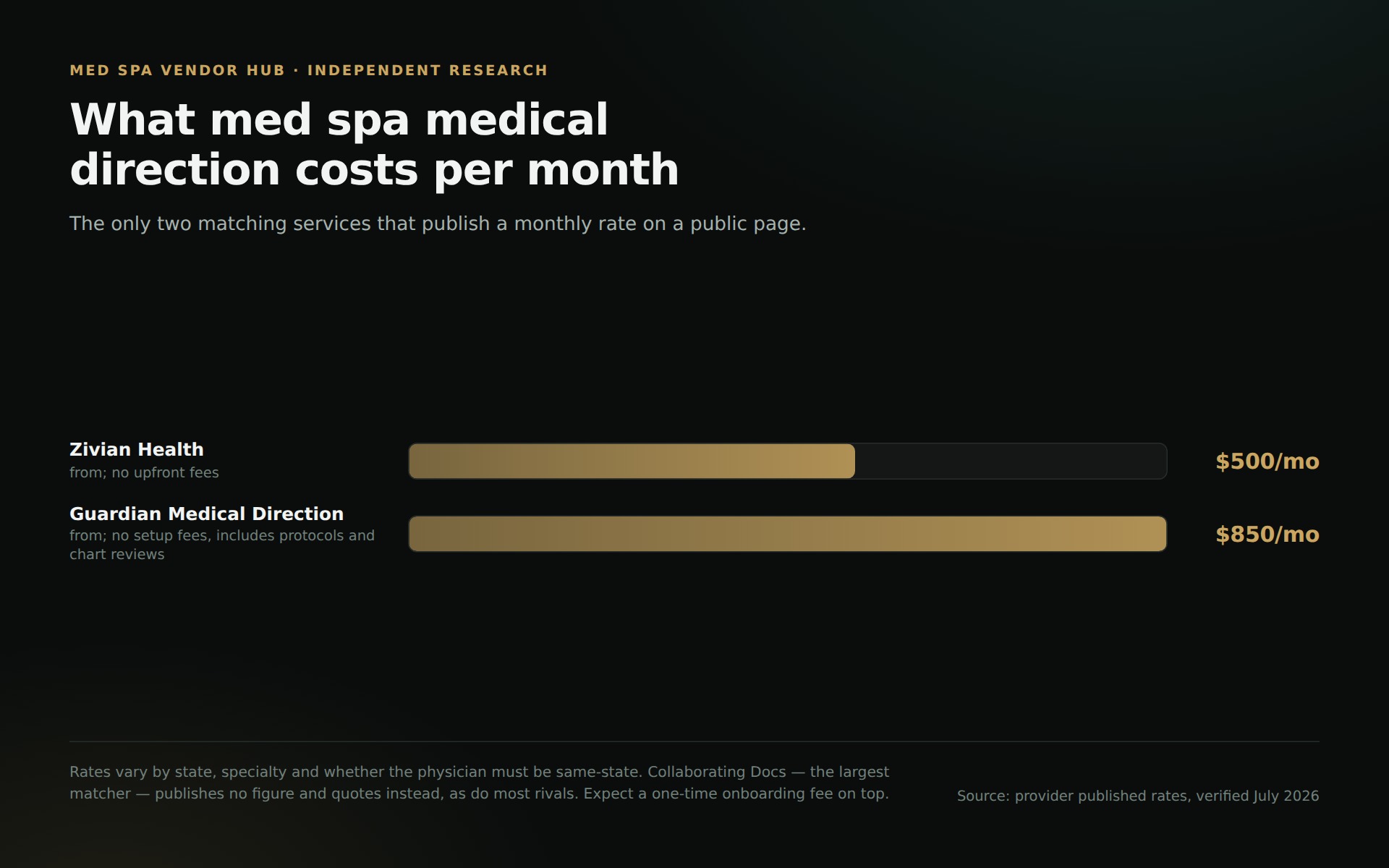
- Only two services publish a rate — Zivian from $500/month and Guardian MD from $850/month; Collaborating Docs quotes rather than publishes. Budget $6,000–$12,000 a year plus a one-time onboarding fee.
- A medical director oversees clinical operations; a collaborating physician supports an NP or PA under a collaborative agreement — you may need one, the other, or both.
- At these prices you are buying infrastructure, not physician hours: protocols, delegation structure, chart review cadence and audit support are what differ between services.
- The absentee "rent-a-doc" arrangement is the specific pattern boards look for, and it exposes the physician’s licence as well as the spa.
- Decide your CPOM/MSO structure before finding the physician — retrofitting a structure around a willing doctor is how agreements fail review.
For most med spas the medical director is not an optional hire — it is the legal precondition for opening at all. In states applying the corporate practice of medicine doctrine, a non-physician cannot own or control a medical practice, and treatments involving neurotoxins, fillers, prescription-strength products and many devices are medical procedures regardless of the setting they happen in.
The market that grew to solve this has become genuinely competent, and unusually transparent about price.
What the role actually involves
A medical director is not a name on a wall. A defensible arrangement typically includes:
- Clinical protocols for every service on the menu, written or approved by the physician.
- Delegation and supervision structure defining which licence types may perform which procedures, and under what oversight.
- Good-faith examinations — the initial patient assessment establishing that treatment is appropriate. Who performs it, and whether it may be done via telehealth, varies sharply by state.
- Chart review and audit at a defined cadence.
- Standing orders and emergency protocols, including adverse-event management.
- Availability for consultation when a clinical question arises.
The distinction between a medical director and a collaborating physician matters and is frequently blurred. A collaborating physician supports an NP or PA operating under a collaborative agreement where the state requires one. A medical director oversees the practice's clinical operations. Depending on your state and structure you may need one, the other, or both.
What it costs
Three matching services publish rates, and they cluster tightly.
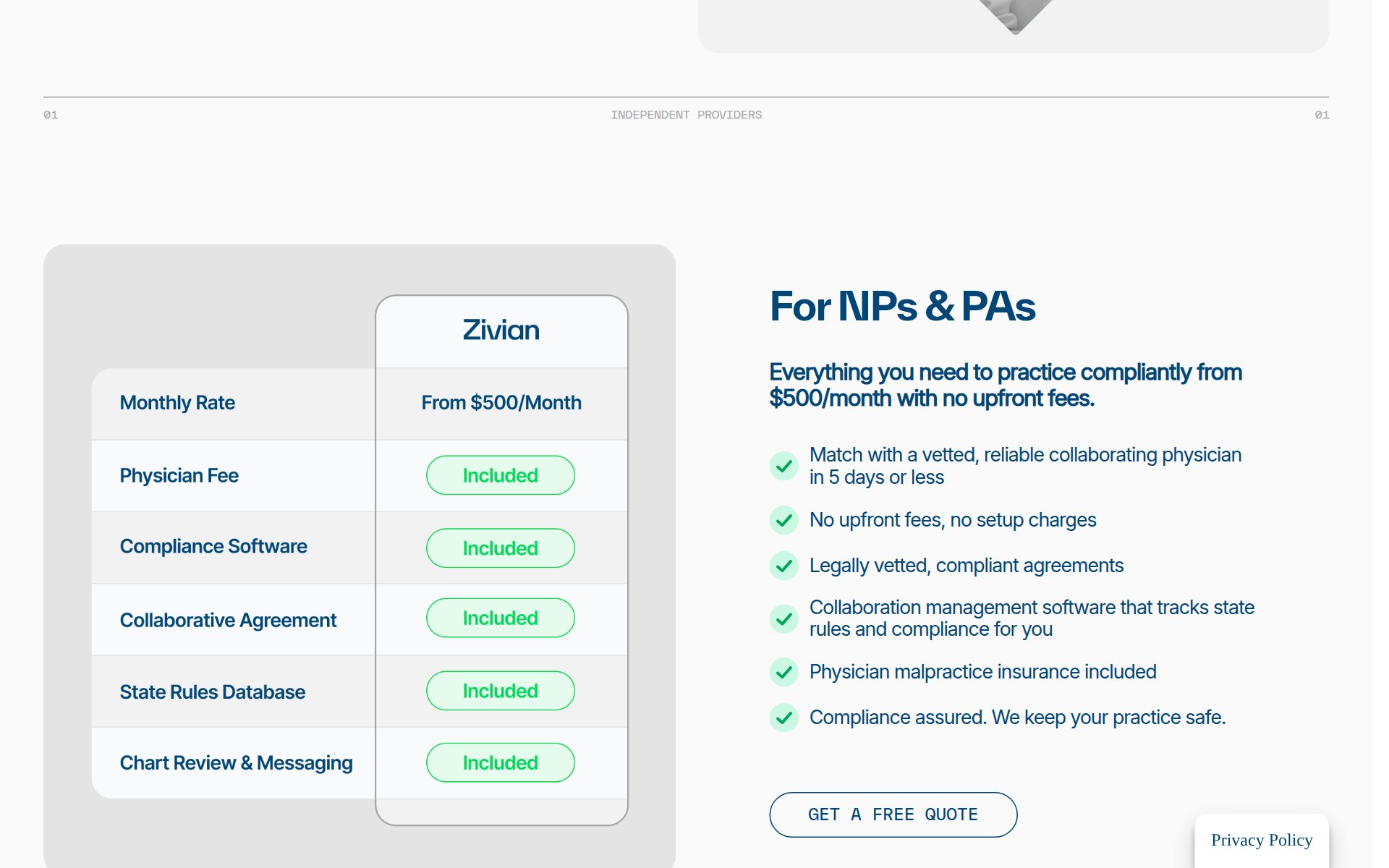
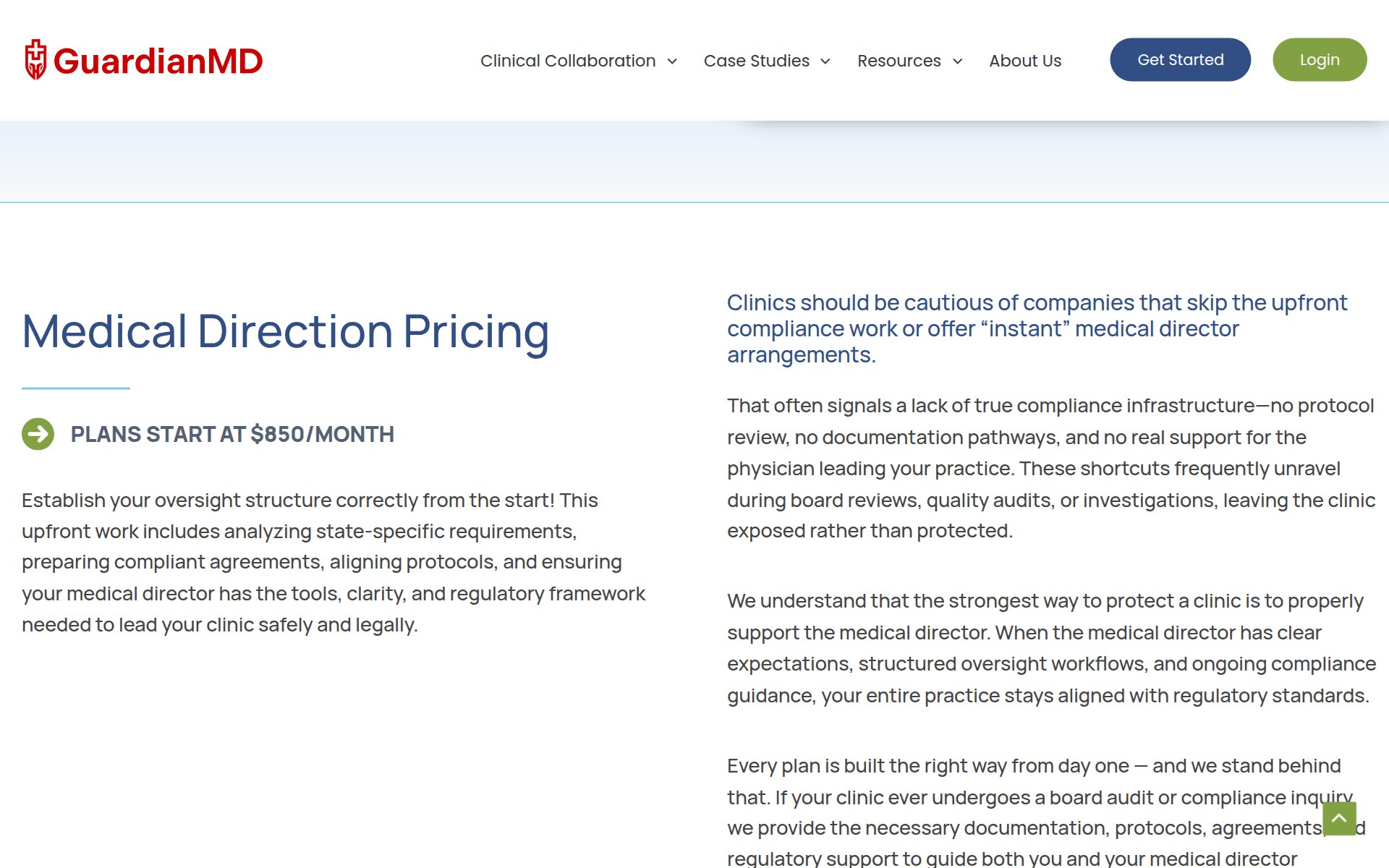
Zivian Health states "everything you need to practice compliantly from $500/month with no upfront fees" on its collaborating-physicians page. Collaborating Docs does not publish a rate at all: its pricing page describes a one-time onboarding fee and a flat monthly fee in words only, then routes you to a quote. Its partner referral pages advertise a match fee being waived — $500 on some, $250 on others — so treat any single figure quoted for it with caution. What it does publish is a guaranteed match in 14 days or less, with physician malpractice and the collaborative agreement included. Guardian Medical Direction publishes plans from $850/month with no setup fees, covering the match plus protocols, CPOM/MSO structuring, chart reviews and audit support.
Doctors For Providers states no upfront search, recruitment or matching fees, with monthly costs varying by state and practice type. Physician Collaborators quotes individually, typically matching within about a week.
Only two of these services put a number on a public page — Zivian at $500/month and Guardian at $850/month. Everyone else quotes. On those two anchors, budget $6,000–$12,000 a year for a compliant arrangement, more where a same-state physician is scarce or the specialty is unusual, and expect a one-time onboarding fee on top with most providers.
What you are really paying for
At these prices the physician's time is a small part of the cost. The difference between services is infrastructure.
A bare match gives you a name, a signature and a monthly invoice. That satisfies the letter of a requirement and leaves you to write protocols, define delegation, set chart-review cadence and manage adverse events yourself. If a board investigates, the arrangement's substance is what gets examined.
Guardian Medical Direction bundles protocols, CPOM and MSO structuring, chart reviews and audit support. Zivian layers a state-rules engine and agreement management over the match, keeping the relationship compliant as rules change. Collaborating Docs includes physician malpractice and collaboration agreements in its fee.
For a single-location spa on a conventional menu, a competent match plus your own protocols may be sufficient. Add IV therapy, weight-loss injectables, hormone therapy or a second location, and the infrastructure stops being optional.
The arrangement regulators dislike
The failure mode has a name in the industry — the absentee or "rent-a-doc" medical director — and it looks like this: a physician who has never visited, does not know the staff, has not reviewed a chart, cannot describe the service menu, and whose only involvement is a monthly payment.
This is the specific pattern boards and plaintiffs' attorneys look for, because it demonstrates the medical oversight was nominal. The consequences are not limited to the spa: the physician's licence is exposed too, which is why serious physicians increasingly decline these arrangements.
Practical markers of a defensible relationship:
- The physician can describe your service menu without prompting.
- Protocols exist in writing, are current, and match what staff actually do.
- Chart reviews happen on a documented cadence, with evidence.
- There is a real, reachable escalation path for adverse events.
- The compensation is for genuine services rendered, structured to respect fee-splitting and kickback rules in your state.
CPOM, MSOs and why structure comes first
In corporate-practice-of-medicine states, a non-physician owner typically cannot own the clinical entity. The standard solution is a two-entity structure: a physician-owned professional entity delivering clinical care, and a management services organisation, owned by the non-clinical operator, providing everything else — premises, staff, marketing, equipment — under a management services agreement.
Get this wrong and the consequences are structural rather than cosmetic: unenforceable agreements, insurance problems, and a business that cannot be sold cleanly. Guardian Medical Direction includes CPOM and MSO structuring in its offering, and any healthcare attorney will address it early — see our compliance and legal buying guide and the Byrdadatto vs Lengea Law comparison.
Sequence matters: decide the structure, then find the physician. Finding a willing physician first and retrofitting a structure around them is how spas end up with agreements that do not survive review.
How to find one
Four routes, in rough order of speed:
- Matching services — Collaborating Docs, Guardian MD, Zivian Health, Doctors For Providers, Physician Collaborators. Fastest route, published or semi-published pricing, matches typically in one to two weeks.
- Your own network — a physician who already knows you is the strongest relationship, if they will genuinely engage.
- Clinician networks — Doximity Talent Solutions reaches a company-reported 85%-plus of US physicians for groups sourcing at scale.
- Aesthetics recruiters — JobSnob, TITAN Aesthetic Recruiting and OnCall for the injector and leadership hires that sit alongside the director role.
Compare the two dedicated services head-to-head in Collaborating Docs vs Guardian MD, and see the recruiting buying guide for hiring the rest of the team.
Frequently asked questions
How much does a med spa medical director cost?
The two services that publish a rate bracket it between $500 and $850 a month: Zivian Health states from $500/month with no upfront fees, and Guardian Medical Direction publishes plans from $850/month with no setup fees. Collaborating Docs, the largest matcher, publishes no figure — its pricing page describes a one-time onboarding fee and a flat monthly fee in words only. Budget $6,000–$12,000 a year on the two published anchors, more where a same-state physician is scarce, and expect a one-time onboarding fee on top.
What is the difference between a medical director and a collaborating physician?
A collaborating physician supports an individual NP or PA under a collaborative practice agreement where state law requires one — the relationship attaches to the clinician. A medical director oversees the clinical operations of the practice itself: protocols, delegation, chart review and adverse-event management. Depending on your state and ownership structure you may need one, the other, or both, which is why the structure question should be settled before you start searching.
Does a med spa legally need a medical director?
In most states, yes, in some form. Neurotoxins, dermal fillers, prescription-strength products and many energy devices are medical treatments regardless of the setting, so they require physician involvement — and in corporate-practice-of-medicine states a non-physician cannot own or control the clinical entity at all. The specific requirement varies significantly by state, so confirm with a healthcare attorney licensed where you operate before opening.
What does a medical director actually have to do?
A defensible arrangement includes written clinical protocols for every service, a delegation structure defining which licence types may do what, a process for good-faith patient examinations, chart review and audit at a documented cadence, standing orders and emergency protocols, and genuine availability for clinical questions. A physician who has never visited, cannot describe your menu and has never reviewed a chart is the arrangement boards and plaintiffs’ attorneys look for.
What is an MSO and do I need one?
A management services organisation is the non-clinical entity in the standard two-entity structure used in corporate-practice-of-medicine states: a physician-owned professional entity delivers clinical care, while the MSO — owned by the non-clinical operator — provides premises, staff, marketing and equipment under a management services agreement. If you are a non-physician owner in a CPOM state, you almost certainly need this structure, and getting it wrong risks unenforceable agreements and a business that cannot be sold cleanly.