Key takeaways
- Salon platforms ($24–$30/mo) and clinical platforms ($148–$176/mo entry) differ by roughly five to seven times, and the gap is the clinical record — not margin.
- Six things salon tools lack: clinical charting, consent tied to a treatment, clinical photography, injectable lot tracking, good-faith exam workflow, and records that outlive the subscription.
- Appointment notes are not treatment notes: free-text, editable and unstructured is not a defensible clinical record.
- The trigger to move is concrete — injecting, buying a device, hiring a medical director, an insurer asking about records, or a client requesting records you cannot produce.
- GlossGenius now sells medspa plans at $148 and $248/month, a middle option between salon and full clinical platforms.
- Model multi-location totals: Boulevard prices per location and Mangomint charges $95–$175/month per extra site plus add-ons.
Most med spas start on salon software, and that is usually the correct decision. The booking, payments, calendar and marketing in the salon tier are genuinely good, and at $24 to $30 a month they cost a fraction of a clinical platform. The problem is not that salon software is bad. It is that it was never designed to hold a medical record, and a med spa eventually needs one.
The price gap, and what it buys
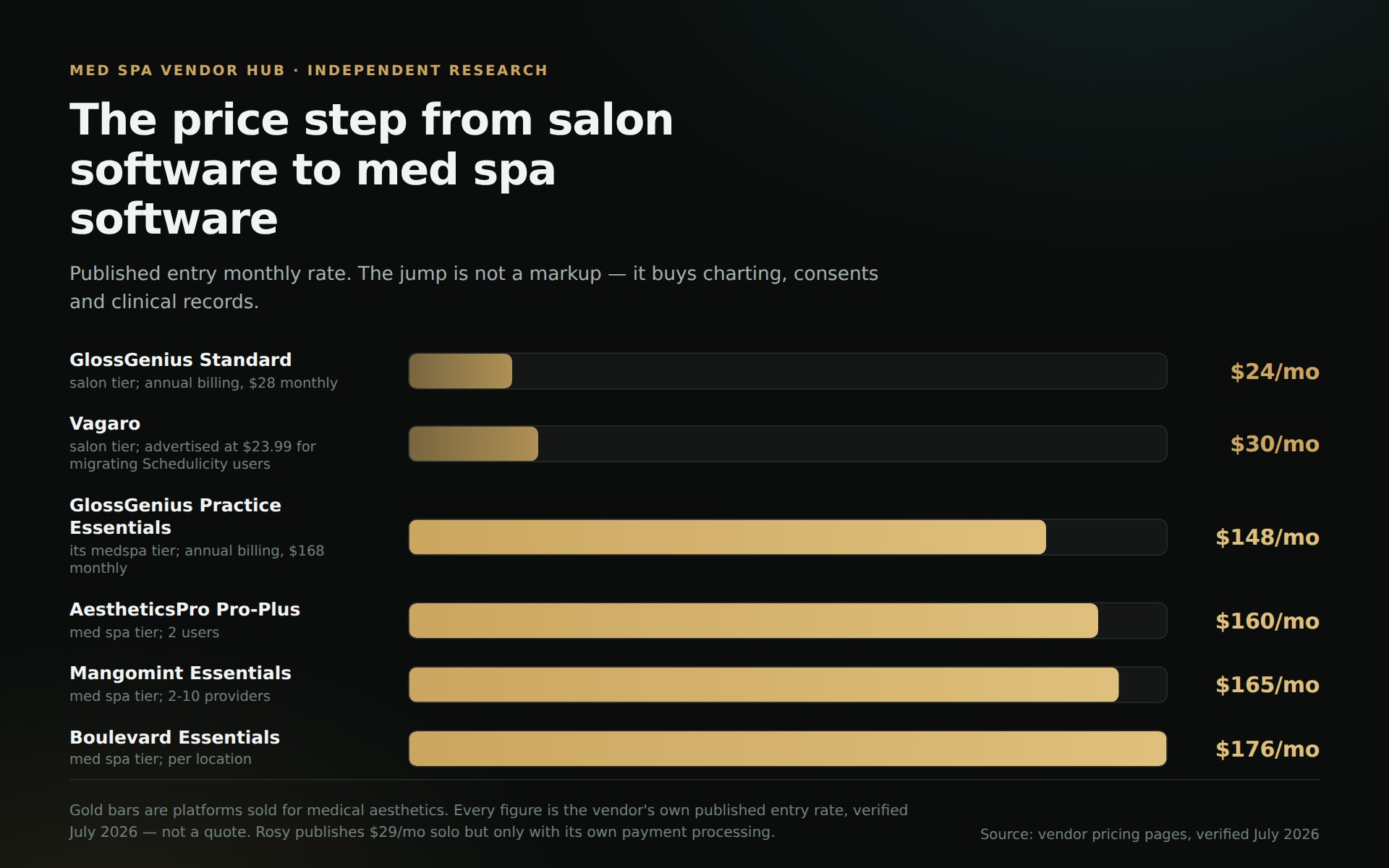
Roughly five to seven times. That multiple looks indefensible right up until you need any of the six things below.
The six capabilities salon tools do not have
1. Clinical charting. A treatment note attached to a patient record, structured, timestamped and attributable to the clinician who wrote it. Salon software has appointment notes — a free-text box, editable, with no clinical structure. They are not the same artefact and will not be treated as the same in a board investigation.
2. Medical consent tied to the treatment. Clinical platforms bind a signed consent to a specific procedure on a specific date. Salon platforms either have no consent capability or a generic intake form that lives apart from the appointment.
3. Clinical photography. Before-and-after images stored against the patient record with standardised capture, dating and consent status — not an album in someone's phone. This is both a clinical necessity and your best defence in a dissatisfaction claim.
4. Injectable lot and batch tracking. Which vial, which lot, which expiry, into which patient. If a product is recalled, this is the difference between a targeted contact list and a catastrophe.
5. Good-faith exam and delegation workflow. Recording that the required examination happened, by whom, and under what supervision — the exact thing regulators look for.
6. Records that survive you leaving. Retention obligations for medical records run for years and are not satisfied by an export of your appointment calendar.
When you are obliged to move
Not "when you have outgrown it" — when the risk becomes concrete. Any one of these is the signal:
- You start injecting neurotoxin or filler, or add any prescription-strength treatment
- You buy a device — laser, IPL, RF, microneedling with RF
- You bring in a medical director, who will ask where protocols and chart reviews live
- Your malpractice carrier asks how records are kept
- You open a second location and start managing them as separate logins
- A client asks for their treatment records and you cannot produce them
The last one is the honest test. If you cannot produce a complete, dated, attributable record of what was done to a patient, you do not have a medical record system, whatever your software costs.
The middle option most people miss
The choice is not binary any more. GlossGenius — a salon brand many owners already use at $24 a month — now sells dedicated medspa plans at $148/month (Practice Essentials) and $248/month (Practice Advanced), billed annually. Staying inside a familiar product while gaining a clinical tier is a materially smaller change than migrating to a new platform, and worth pricing before you assume you have to move everything.
What the clinical tier actually costs
Verified published entry rates: AestheticsPro Pro-Plus at $160/month for two users, Mangomint Essentials at $165/month for 2–10 providers, Boulevard Essentials at $176/month per location. Above those, Mangomint runs $245 and $375, and Boulevard $293 and $410, with per-location fees on top.
Two details that change the real number: Boulevard prices per location, and Mangomint charges $95–$175/month for each additional location plus add-ons for charting ($50), calls and messaging ($75) and payroll ($50). A two-site practice should model the total, not the headline.
For the full decision framework see how to choose med spa software; for budgets, what med spa software costs; and for the two leading clinical platforms head to head, Boulevard vs Mangomint.
If you are staying on salon software for now
That is a legitimate position for a non-medical menu. Make it deliberate rather than accidental:
- Keep consent and clinical photos in a system that is actually built for them, even if booking stays where it is
- Do not use appointment notes as a substitute for a treatment record
- Diarise a review for the moment your menu changes — adding a device or an injector is the trigger
- Confirm you can export everything as files you hold yourself
And if you arrived here because your booking software changed hands, Schedulicity is now Vagaro explains what that migration involved.
Frequently asked questions
Can I run a med spa on salon software?
For a non-medical menu — facials, waxing, lashes, massage — yes, comfortably. The moment you inject, run an energy device, or take a medical history, salon software stops being sufficient: it has no clinical charting, no consent bound to a treatment, no clinical photo management and no injectable lot tracking. Those are not conveniences; they are what a treatment record is made of.
Why is med spa software five times the price of salon software?
Almost entirely the clinical layer. Published entry rates run $24–$30/month for salon platforms against $148–$176/month for clinical ones. The difference buys structured treatment notes attributable to a clinician, consent tied to a specific procedure and date, clinical photography with consent status, injectable lot and batch tracking, and good-faith exam and delegation workflow. If you never need those, the cheaper tier is the right buy.
What is the cheapest med spa software that has clinical features?
On published pricing, GlossGenius Practice Essentials at $148/month billed annually is the lowest clinical-tier entry point, followed by AestheticsPro Pro-Plus at $160/month for two users, Mangomint Essentials at $165/month and Boulevard Essentials at $176/month per location. Check what each includes at entry — charting is a $50/month add-on on Mangomint rather than part of the base plan.
When exactly do I have to move off salon software?
When the risk becomes concrete rather than theoretical: you start injecting or add a prescription-strength treatment, you buy a device, you bring in a medical director who needs somewhere for protocols and chart reviews, your malpractice carrier asks how records are kept, or a client requests treatment records you cannot produce. That last one is the clearest test of whether you have a medical record system at all.
Are appointment notes good enough as treatment records?
No. Appointment notes are a free-text field — editable, unstructured, and generally not attributable to a specific clinician at a specific time. A clinical treatment note is structured, timestamped, attributed and retained. In a board investigation or a claim, the difference is the entire point, and it is not one you can argue your way out of after the fact.